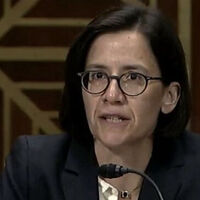
Panelist Inés Yábar, UN Youth Office Expert: Young Leaders for the SDGs. Photo: UN Women/Jennifer Graylock

“We feel the weight of the challenges of conflict and crisis. But we all also recognize the power of women’s leadership, from this room to our local communities,” said UN Women Executive Director Sima Bahous, opening the event. “And we are determined to give everything for the most profound yet simplest change which makes the biggest difference: equality for women and girls.”

As conflicts and wars continue to devastate communities worldwide, Melanne Verveer, Executive Director of the Georgetown Institute of Women, Peace and Security underscored, “Women have an essential role to play in peace and security. However, we also know that women are consistently being sidelined. That has to change, and it is an evidence-based case today.”

The panelists, all members of the UN Women Leaders Network, shared concrete solutions and real-life examples of women’s leadership in conflict prevention, peace negotiations, humanitarian response and post-conflict reconstruction.

“There is hope in knowing that all of us – whatever leadership position we hold – we can also help move that needle. That is something that we can view as agency for ourselves, as well in our communities around the world; that we can also change the course of history,” said Inés Yábar, who serves as the UN Youth Office Expert: Young Leaders for the SDGs.

  • The UN Women Leaders Network UNGA80 side event took place in front of a full audience on 26 September 2025 in New York. Photo: UN Women / Jennifer Graylock
  • UN Women Executive Director Sima Bahous delivers opening remarks. Photo: UN Women / Jennifer Graylock
  • Chair of the panel, Melanne Verveer, Executive Director of the Georgetown Institute of Women, Peace and Security. Photo: UN Women / Jennifer Graylock
  • Tawakkol Karman, Nobel Peace Prize Laureate (2011). Photo: UN Women / Jennifer Graylock
  • Former Prime Minister Helen Clark of New Zealand (1999–2008) and Inés Yábar, UN Youth Office Expert: Young Leaders for the SDGs. Photo: UN Women / Jennifer Graylock
  • Panelist Hibaaq Osman, CEO & Founder, Karama (centre) is joined by (left to right) Shola Mos Shogbamimu, Anino Emuwa, Yasmeen Hassan, and Lopa Banerjee. Photo: UN Women / Jennifer Graylock
  • Former President Tarja Halonen of Finland (2000–2012) (centre) is joined by Melanne Verveer and Inés Yábar. Photo: UN Women / Jennifer Graylock
  • UN Women Executive Director Sima Bahous with panelist Susana Malcorra, President and Co-Founder, GWL Voices. Photo: UN Women / Jennifer Graylock
  • Stefanía Sigurdís, Youth Representative of the Government of Iceland. Photo: UN Women / Jennifer Graylock
    • The UN Women Leaders Network UNGA80 side event took place in front of a full audience on 26 September 2025 in New York. Photo: UN Women / Jennifer Graylock
    • UN Women Executive Director Sima Bahous delivers opening remarks. Photo: UN Women / Jennifer Graylock
    • Chair of the panel, Melanne Verveer, Executive Director of the Georgetown Institute of Women, Peace and Security. Photo: UN Women / Jennifer Graylock
    • Tawakkol Karman, Nobel Peace Prize Laureate (2011). Photo: UN Women / Jennifer Graylock
    • Former Prime Minister Helen Clark of New Zealand (1999–2008) and Inés Yábar, UN Youth Office Expert: Young Leaders for the SDGs. Photo: UN Women / Jennifer Graylock
    • Panelist Hibaaq Osman, CEO & Founder, Karama (centre) is joined by (left to right) Shola Mos Shogbamimu, Anino Emuwa, Yasmeen Hassan, and Lopa Banerjee. Photo: UN Women / Jennifer Graylock
    • Former President Tarja Halonen of Finland (2000–2012) (centre) is joined by Melanne Verveer and Inés Yábar. Photo: UN Women / Jennifer Graylock
    • UN Women Executive Director Sima Bahous with panelist Susana Malcorra, President and Co-Founder, GWL Voices. Photo: UN Women / Jennifer Graylock
    • Stefanía Sigurdís, Youth Representative of the Government of Iceland. Photo: UN Women / Jennifer Graylock

    The distinguished speakers called for bold action, putting concrete measures in place to ensure women have an equal say in all peace and security decisions:

      Increase women’s meaningful involvement in the prevention and resolution of conflicts, peace negotiations, peacebuilding, peacekeeping, humanitarian response and in post-conflict reconstruction;Ensure women’s equal participation, decision-making and full involvement in all efforts for the maintenance and promotion of peace and security;And devise policies and plans to ensure accountability to enforce and maintain gender-equal participation in peace processes.

    Helen Clark, former Prime Minister of New Zealand (1999–2008), reflected on how local peacebuilding is already showing results, and called on global leaders to step up: “Nonetheless, it would be rather nice to have more political commitment at higher levels to match the effort on the ground [...] and have that commitment across society – as part of the recoveries we’re building to this gender-equal, fair and equitable society.”

    The gathering also laid the groundwork for shaping a Call to Action on Women’s Leadership for Peace, which is set to be developed by the UN Women Leaders Network in the coming months.

    As the world reflects on 25 years of the Women, Peace and Security agenda, and looks ahead to the next decade, the message from this event is clear: Lasting peace, for everyone, depends on women’s leadership. When women lead, peace follows.

  • More Christchurch News

    Access More

    Sign up for Christchurch News

    a daily newsletter full of things to discuss over drinks.and the great thing is that it's on the house!